Remote Coding from Your Phone or Tablet
Remote coding means editing and running the project on one machine while you interact from another. The most common setup is a phone or tablet connecting over SSH to your desktop, laptop or server, and working in the real repository instead of a copy.
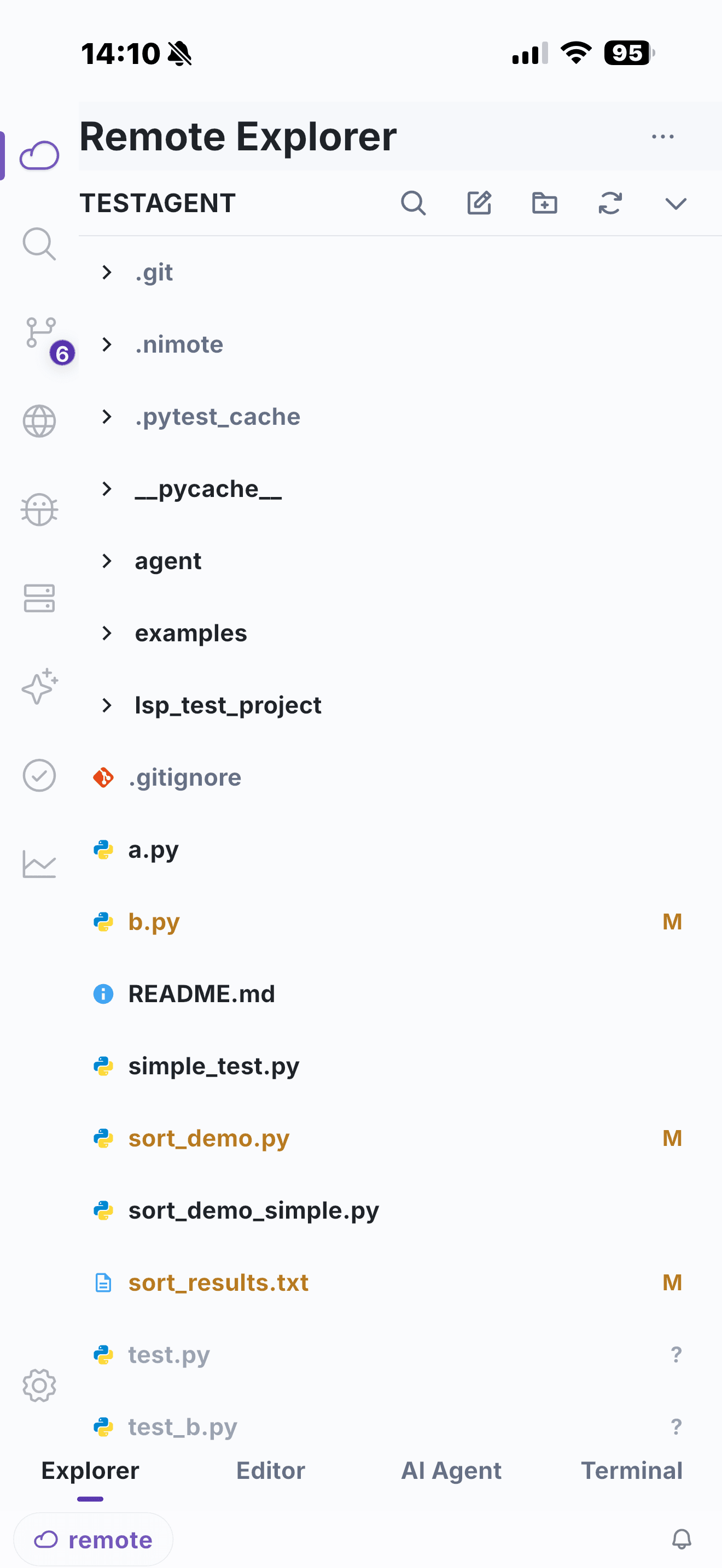
NimoteCode is a mobile workspace built for that model. Instead of reducing remote coding to a stream of shell text, it gives you an Explorer for the project, an editor for the files, a terminal for commands, Git for review and AI assistance for context — all connected to the same remote host.
What remote coding actually requires
A workable remote setup needs three things: a host you trust and can reach over SSH, a connection that survives mobile network changes, and a workspace that keeps files, terminal and Git together. Tools that only give you one of those — a plain SSH client, or an editor with no connection — leave the loop broken.
When remote coding is useful
- Your codebase lives on a Mac, Linux desktop or server and you are away from it.
- You need to investigate an incident, apply a small fix or review a diff remotely.
- You travel with a phone or tablet and want to keep a task moving.
- You prefer the remote machine's full tooling and compute over local emulation.
How NimoteCode fits
Connect through SSH workspace, pick the project root, and the repository stays on the host. Your phone or tablet works with the real files: browse in Explorer, edit in tabs, run checks in Terminal and inspect Git history without copying anything to the device. For projects already on the device, the same workspace opens them locally.
A typical remote coding session
- Open the SSH profile and connect to your development host.
- Locate the relevant module or file in the project Explorer.
- Edit the smallest required change in the editor.
- Run the focused test, build or log command in Terminal.
- Review the staged and unstaged result in Source Control.
- Use AI Chat and Agent to explain an error or plan the next step with full project context.
The remote versus local difference
- Remote: project, tooling and compute stay on the host; the phone reads and edits it over SSH. Best for existing machines, servers and heavy projects.
- Local: project files live on the device and open without a network. Best for quick experiments and offline work, but limited by phone storage and compute.
Limitations of remote coding
Remote coding depends on the network and the host. On a weak connection you will feel latency in keystrokes and terminal output; reconnect-aware handling helps but does not remove it. Very large repositories can take time to browse until search indexes are ready. And the host does the heavy work — a phone cannot speed up an underpowered server. For long, heavy compile loops, a desktop remains the more comfortable place.
Frequently asked questions
What does remote coding mean in practice?
Remote coding means editing and running the project on one machine while you interact from another. The most common setup is a phone or tablet connecting over SSH to your desktop, laptop or server and working in the real repository.
Is remote coding over SSH slow?
Interactive editing over SSH is generally responsive on a good connection. Heavy operations — large builds, full reindexing or long-running compiles — are subject to your network and the remote host, and are often better left to the desktop.
Do I need the project files on my phone?
No. With an SSH workspace the project stays on the remote host. Your phone reads and edits the files over SSH and sees the terminal output and Git data from that machine, instead of duplicating the repository.
Keep your project, terminal and Git review with you wherever you are.