Agent Design is Bounded Optimization, Not Intelligence
AI agents are often described as intelligent systems. After building and iterating on several agent systems, a different pattern became clear:
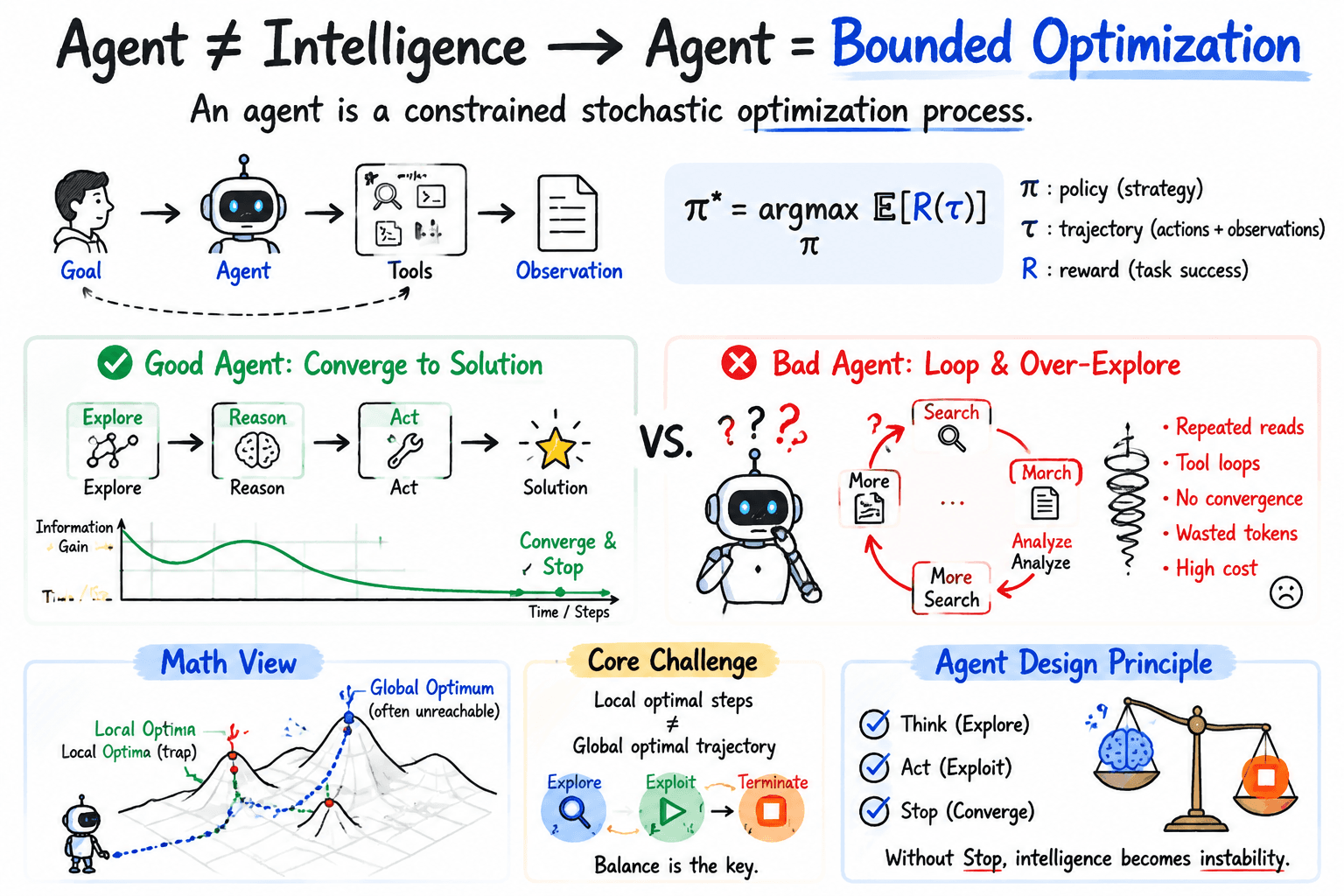
An agent is not intelligence. It is a bounded optimization process operating over partial information.
1. Formal view of an agent
We can define an agent policy as π* = arg max π E[R(τ)], where:
πis the policy (decision function)τis the trajectory (sequence of actions plus observations)Ris the reward function
At each step, the agent selects a* = arg max a E[Q(s*, a)].
2. The real-world constraint
In real systems, those assumptions break:
- State is partially observable
- Rewards are sparse and delayed
- Tool outputs are stochastic and noisy
- The environment is non-stationary
So the agent is not solving global optimization. Instead it performs:
local greedy optimization over incomplete state
3. Why agents fail: looping behavior
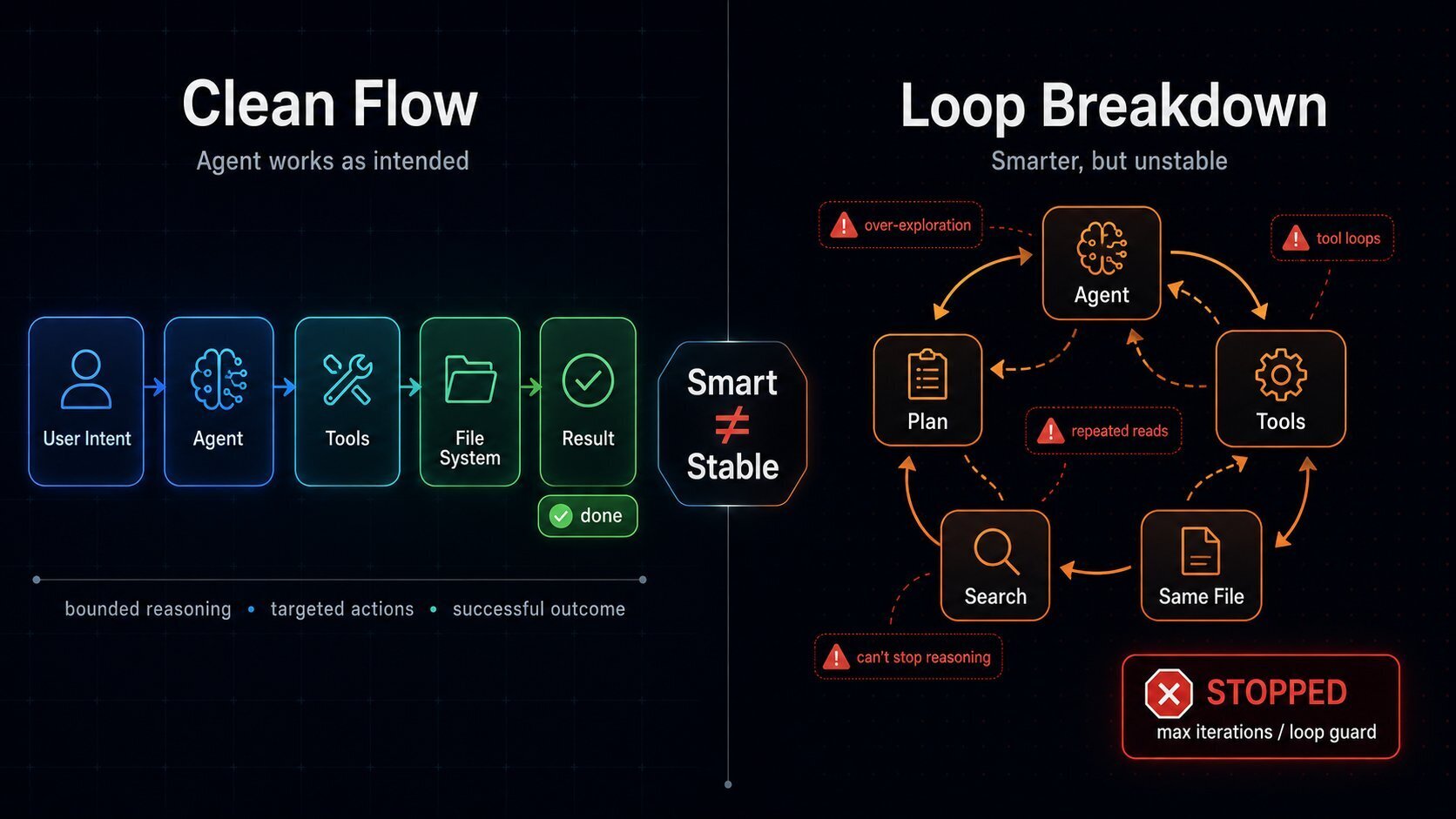
A key failure pattern emerges in practice: repeated file reads, redundant tool calls, over-exploration of the same context, and non-terminating reasoning loops.
Why does this happen? Because locally, every action still has positive expected utility. So from the agent's perspective, continuing to explore is always "reasonable". This leads to optimization loops.
4. The missing dimension: termination
Most agent designs focus on reasoning capability, tool usage and planning quality—but ignore a critical axis:
When should the agent stop?
Without termination control, the system degenerates into infinite exploration, tool loops and unstable execution trajectories.
5. Agent design space
Agent behavior is fundamentally a trade-off between:
- Exploration (gathering information)
- Exploitation (executing actions)
- Termination (converging on output)
You can think of this as a constrained optimization system rather than pure reasoning.
6. The bounded optimization perspective
A more accurate framing:
Intelligence = optimization · Agent = bounded optimization · Engineering = defining the bounds
Those bounds include exploration budgets per module, loop detection mechanisms, phase separation (analysis → planning → execution) and early-stopping heuristics.
7. The key insight
Improving reasoning alone often increases instability, because stronger reasoning tends to increase exploration depth, raise tool invocation frequency and delay convergence. Without proper constraints, this leads to worse overall behavior.
Conclusion
An agent is not a system that "thinks better". It is a system that optimizes under constraints and knows when to stop optimizing.
In practice this is exactly why agent workflows need guardrails: a controlled multi-step agent can inspect files, run commands and propose changes, but it still needs boundaries and review. See how that plays out in a real workspace in AI Agent demo and the AI Chat & Agent guide, and read a live demo in Can an AI Agent Really Code From a Phone?. For the wider product view, start with Mobile AI Coding.
Related content
- Mobile AI coding workspace — guardrails and review in a real mobile workspace
- Can an AI Agent Really Code From a Phone? — a live agent demo over SSH
- AI Agent demo — inspect, plan, execute and verify on mobile
About the author · Building NimoteCode, a mobile-first IDE built with Flutter and Rust. Follow the project on DEV.to · GitHub · X.